
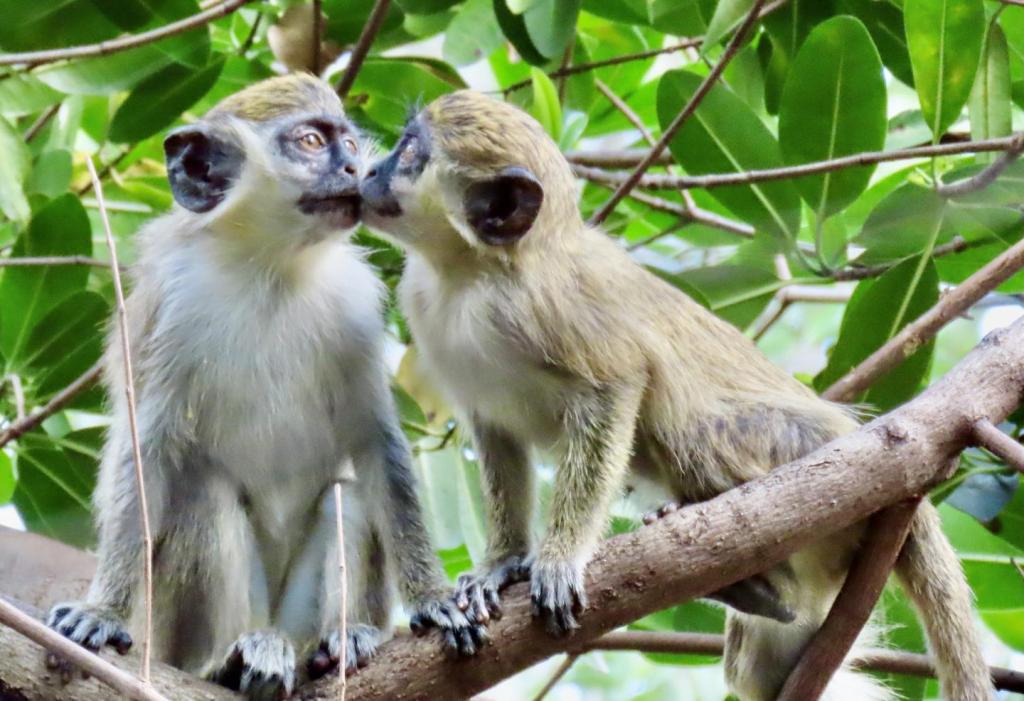
DANIA BEACH, Fla. — South Florida has a colony of monkeys living beside an international airport, which somehow does not even rank among Broward County’s five strangest developments.
The animals have spent nearly 80 years in the mangroves near Fort Lauderdale-Hollywood International Airport, raising families, dodging trouble and declining to explain why their ancestors never booked a return flight. Now the question is whether Florida should give these unusual neighbors special protection—or continue treating them as outsiders.
The Great Escape of 1948
Unlike most Florida wildlife stories, this one did not begin with somebody releasing a pet into a canal. It began with the Anthropoid Ape Research Foundation, later known as the Dania Chimpanzee Farm, which imported African primates for a zoo and biomedical research, including polio-related work.
In 1948, monkeys escaped. Some were recaptured; others settled into nearby mangroves and apparently decided the accommodations were acceptable. A 2021 genetic study traced today’s colony to that escape and identified the animals as Chlorocebus sabaeus, green monkeys native to West Africa—not the East African species suggested in some older accounts.
So no, the monkeys did not swim across the Atlantic. Humans brought their ancestors here. The monkeys merely handled the relocation paperwork in their own way: by ignoring it.
Broward County’s Longest Layover
Today, the colony occupies a peculiar patchwork of mangroves, parking lots and airport-adjacent industrial land. The setting offers excellent access to transportation, although the monkeys have shown little interest in Spirit Airlines.
A University of Florida review reported about 40 monkeys in four groups in 2020. In August 2026, primatologist and sanctuary director Missy Williams estimated fewer than three dozen. These are estimates from different years—not a current census, and certainly not the opening phase of a primate takeover.
The Dania Beach Vervet Project monitors the colony, helps injured animals and educates the public. Its work matters because even a monkey with decades of local family history cannot negotiate with a bulldozer.
To the casual passerby, spotting a monkey near an airport parking lot might seem like a free attraction thrown in with the hourly rate. But these are social animals with families and routines, living in a small habitat surrounded by a very large city. They need more than an enthusiastic audience with camera phones.
Florida Says They’re Not From Around Here
Legally, the monkeys remain nonnative wildlife. In Florida, where half the population seems to have arrived from somewhere else, this is an especially awkward distinction.
Williams told CBS Miami that staff can obtain permits to treat injured wild vervets, but taking one into captivity creates obstacles to returning it to its family. She has discussed seeking a different classification so rescued monkeys could receive care and be released.
The irony: humans transported the animals here, and generations later the animals are the ones facing questions about where they belong.
Should Florida Protect Them?
Supporters argue that a small, long-established colony deserves humane protections. A 2026 Science News report described a local test that found no evidence of these monkeys taking birds’ eggs. But scientists still cannot say their full ecological impact is understood.
Others worry about the precedent. Zoo Miami Foundation wildlife expert Ron Magill cautioned in the August report that declaring a nonnative animal native simply because it has been around a long time could complicate protection of Florida’s actual native species.
That leaves an interesting middle ground: Could Florida protect this particular colony, and allow appropriately treated monkeys to return to their families, without rewriting the definition of “native”? Protecting an animal from harm and declaring it indigenous are two different decisions. Even Florida should be able to handle two forms.
A tailored permit or management policy could address care for these existing animals without giving every introduced species a claim to permanent residency. That is less catchy than declaring the monkeys honorary Floridians, but it takes both animal welfare and native habitats seriously. Neither issue becomes simpler because the animals are exceptionally photogenic.
The Dania Beach monkeys did not choose their journey, their address or the laws governing them. They inherited a South Florida life from ancestors who escaped in 1948 and never looked back.
So, nearly eight decades later, should they become a protected local colony—or should their nonnative status take priority? The monkeys, who have no lobbyists and have yet to attend a county commission meeting, remain unavailable for comment.
For visitors: Observe wild monkeys from a distance. Florida prohibits feeding wild monkeys; do not approach, feed or attempt to handle them.
Reporting: Williams et al., Primates (2021); Science News (March 2026); CBS Miami (August 2026); University of Florida IFAS; Dania Beach Vervet Project.
Featured photograph: Two wild vervet monkeys in the mangroves of Dania Beach, photographed by Aaron Mencia for Florida Atlantic University. Image source / credit.
About the writer

Laurel Finch covers wildlife, neighborhood ecology and the occasional highly organized reptile for The Tea Bag Times™. She reports on the uneasy—and sometimes surprisingly neighborly—relationship between South Florida and its animals. Read Laurel’s stories.
Keep Reading



Leave a Reply