
By Nobuto “Nobu” Kazuma | Founder & Editor-in-Chief
OPINION — I picked up Edward L. Bernays’s Propaganda expecting a history lesson. Instead, I made it through the opening chapter and briefly considered apologizing to every opinion I have ever called my own.
The book was published in 1928. Its first chapter is called “Organizing Chaos,” which sounds like the name of a committee created to fix a committee. But its opening argument is considerably more unsettling than the title suggests.
Bernays describes the deliberate shaping of people’s habits and opinions as an important feature of democratic society. He calls the people behind that process an “invisible government.”
And then comes the sentence that made me stop turning pages:
“We are governed, our minds are molded, our tastes formed, our ideas suggested”
Edward L. Bernays, Propaganda (1928), Chapter I, “Organizing Chaos”
That is not an influencer warning you to wake up while promoting a sponsored mattress. That is a pioneer of public relations calmly describing how public opinion works, nearly a century ago.
The Invisible Government Does Not Need a Secret Headquarters
It is tempting to read “invisible government” and imagine a dimly lit room full of people in matching robes, voting on whether your favorite cereal should cost another dollar.
That is not quite Bernays’s argument. He is describing influential people, institutions and communicators who help determine which ideas reach the public and how those ideas are presented. In a complicated society, he argues, most of us cannot independently investigate every candidate, product, policy or claim. We rely on other people to organize the information.
What got me was not just the notion that our choices can be shaped. It was how matter-of-factly Bernays treated the arrangement. He was not simply warning readers against propaganda; he was explaining—and, in places, defending—organized persuasion as part of modern life.
No dramatic music. No emergency broadcast. Just the possibility that your very personal preference arrived with a professionally prepared introduction.
The Machinery Got an Upgrade
In 1928, Bernays was writing about a world of newspapers, advertising, public figures, civic organizations and mass communication. He did not invent social media or predict the code behind your favorite app.
But the question his opening chapter raises fits rather neatly inside a smartphone screen: Who decided what you would see first?
Consider a story that appears in your feed, a brand that somehow feels familiar, or an opinion that seems to be everywhere. Someone may have written the message. Someone else may have paid to distribute it. A platform may have chosen when to show it. Your friends may have shared it.
None of those people necessarily met in a secret room. They may not even know one another. Yet together they can shape what feels important, popular or obvious.
We call it “keeping up with the world.” The advertising department calls it reach. The algorithm calls it Tuesday.
Not Every Influence Is a Conspiracy
There is an important distinction here. Persuasion is not automatically dishonest, and being influenced does not mean you have surrendered your free will. Public-health campaigns can save lives. Journalism can expose wrongdoing. Advocates can bring neglected problems into view.
And Bernays had a point about information overload: nobody can personally verify every fact needed to get through an ordinary day. Some degree of trust and filtering is unavoidable.
The real question is whether we know who is doing the filtering, why they are doing it and what they stand to gain.
When influence is visible, we can examine it. When it disappears into the wallpaper of everyday life, we may mistake somebody else’s priorities for our own instincts.
A Small Confession From the Newsroom
I should admit that The Tea Bag Times™ is not floating above all this in a magnificent cloud of journalistic purity. We write headlines. We choose angles. We decide which details make the story and which details stay in the notebook.
This article has a headline designed to catch your eye. I selected the passage that startled me and framed it around the world we live in now. That is influence, too.
The difference I hope matters is whether we are transparent about what we are doing, show our sources and leave readers enough room to make up their own minds. Even an opinion column should not pretend to be a message delivered by the universe itself.
Perhaps the simplest defense against unseen persuasion is to start noticing who is asking for our attention—including the people serving us the news.
Before You Scroll Away
I am still reading Propaganda, and I do not expect to agree with everything Bernays wrote. But the first pages have already changed the question I ask when I encounter a popular idea.
It is no longer just, “Do I believe this?”
It is also, “How did this get in front of me—and who benefits if I do?”
A book published in 1928 should not feel like it is describing the atmosphere of 2026. Yet here we are, holding tiny screens that serve us information in carefully arranged portions and calling the experience freedom of choice.
At press time, I was trying to form an independent opinion about the book. My phone was eager to recommend several.
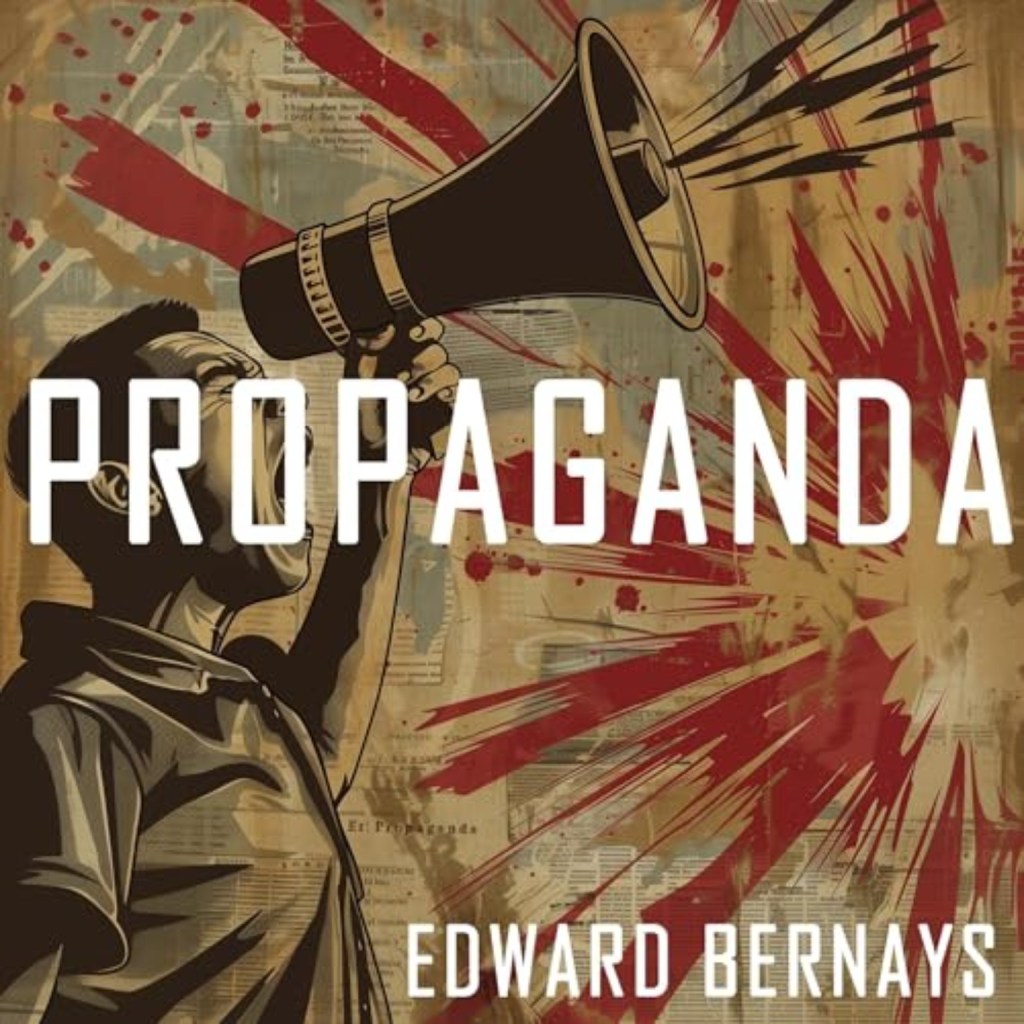
Source: Edward L. Bernays, Propaganda (New York: Horace Liveright, 1928), Chapter I, “Organizing Chaos,” p. 9. Read the original text via Project Gutenberg. This column reflects the writer’s interpretation of the opening chapter. Featured artwork: Reader-supplied illustration inspired by the themes of Edward L. Bernays’s Propaganda.
About the writer

Nobuto “Nobu” Kazuma, founder and editor-in-chief of The Tea Bag Times™, holds the facts to a higher standard than his introductions. He believes in absolute honesty on the page—and just enough creative license everywhere else. Meet our newsroom.
Keep Reading




Leave a Reply